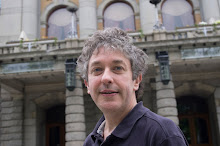
TODAY'S interesting photo of The Edinburgh Fringe Survival Guide comes courtesy of Queen Allen who's acting in Words and Women with Skyers Productions at the Street as part of PBH's Free Fringe. What a fine production it must be.
A leading art critic writes: "The picture demonstrates admirably, and in some ways, subversively, the symbiotic relationship between the Fringe Programme and The Edinburgh Fringe Survival Guide, while capturing something of the tension, fragmentation and excitement that builds as the world's biggest arts festival approaches. It is a work of troubled genius - rather like that one with the grateful puppet."
Follow these links for yet more interesting pictures:
http://edinburghfringesurvivalguide.blogspot.co.uk/2012/07/hooray-for-blitz-sisters.html
And here:
http://edinburghfringesurvivalguide.blogspot.co.uk/2012/06/babies-puppets-and-swimming-pools-read.html
Sunday, July 29, 2012
Saturday, July 28, 2012
Full line-up of Edinburgh Fringe Surivival Guide Live!
Winners of Olivier Awards, Fringe Firsts, Edinburgh Comedy Awards and Herald Angels join critic for stage version of acclaimed Edinburgh Fringe book
THEATRE critic Mark Fisher is moving across the footlights to present a show on the Edinburgh Festival Fringe. Following the publication of The Edinburgh Fringe Survival Guide in February, the Edinburgh journalist is hosting a chat show, supported by the Pleasance Theatre Trust, based on his celebrated book and recorded as a podcast, live in front of an audience.Line-up and booking details below.
Thursday 9 August
Top tips about success on the Fringe from Kath Mainland, chief executive of the Edinburgh Festival Fringe Society, Orla O'Loughlin (pictured), artistic director of the Traverse Theatre, Aneke McCulloch, producer with Seesault, Australia, and Tess Waters, performer in Sexytime!
Friday 10 August
First-hand insights into getting your Fringe show noticed from Lyn Gardner (pictured), Guardian theatre critic, Brian Logan, Guardian comedy critic, and Miriam Attwood, former media manager for the Fringe Society now press officer for the National Galleries of Scotland and Finn Anderson, writer of Streets the Musical.
Thursday 16 August
Essential advice about surviving week two and beyond from Cora Bissett (pictured), Oliver Award-winning director of Roadkill, Guy Masterson, Oliver Award-winning director of Morecambe, Ian Fox, author of How to Produce, Perform and Write an Edinburgh Fringe Comedy Show, and Teresa Burns, co-director of How It Ended Productions.
Friday 17 August
How to have the last laugh as a Fringe comedian with Phil Nichol, Edinburgh Comedy Award winner, Josie Long (pictured), Edinburgh Comedy Award best newcomer 2006, and Jessie Cave, comedian, actor and Harry Potter star.
Thursday 23 August
How to deal with disappointment and make the most of a hit with Hannah Eidinow (pictured), five-times Fringe First winning director, Judith Doherty, producer of the multi-award winning Grid Iron, Peter Michael Marino, writer of West End flop Desperately Seeking Susan, and Nicola Foxfield, assistant producer with Fringe first-timers Hecate Theatre.
Friday 24 August
Expert advice on developing your post-Fringe career from Vicky Featherstone (pictured), artistic director of the National Theatre of Scotland, Camille O'Sullivan, singing star of the Fringe and the Edinburgh International Festival, and Toby Gough, Herald Archangel-winning director.
Venue: Cabaret Bar, Pleasance Courtyard (Venue 33)
Dates: 9, 10, 16, 17, 23 & 24 August 2012
Time: 11.30am (one hour)
Tickets: £4 (£3)
Tickets: £4 (£3)
Box office: 0131 556 6550
Internet: www.edfringe.com and www.pleasance.co.uk
Monday, July 23, 2012
Hooray for the Blitz Sisters
![]() |
| Two Blitz Sisters prove reading is good for you |
I have a similar liking for all the wonderful Edinburgh Fringe people on my earlier post here.
If you have a picture featuring The Edinburgh Fringe Survival Guide or tickets for The Edinburgh Fringe Survival Guide: Live!, then send it along just as fast as you can.
Sunday, July 15, 2012
What the Avignon Off teaches you about selling your Edinburgh Fringe show
![]() |
| LR: Faith Liddell, Kath Mainland and Rupert Thomson |
In the panel discussion, Jonathan Mills, artistic director of the Edinburgh International Festival, talked about his prestigious cross-artform programme; Kath Mainland, chief executive of the Edinburgh Festival Fringe Society, laid out the open access principles that underpin her work; Faith Liddell of Festivals Edinburgh gave an overview of the city's 12 major festivals; Rupert Thomson of Summerhall and Vincent Guérin of the Institut francais d'Ecosse gave an insight into the way their programmes work; and I conducted an interview with recent and imminent French visitors to the Fringe.
Knowing I'd be there for little more than 24 hours and wouldn't have the time to see more than one show, I had made no attempt to find out what else was on. That meant it was only while sitting in a pavement restaurant in Avignon that I first laid eyes on the programme for the three-week Avignon Off, the Francophone answer to the Edinburgh Fringe.
Was this, I wondered, what it felt like for a newcomer to be confronted by the Fringe Programme for the first time? For here was a 396-page guide that was stuffed with plays I'd never heard of, performed by companies I didn't recognise, taking place in venues that could have been anywhere in this unfamiliar town.
Such a profusion of artistic activity was both tremendously exciting and utterly bewildering. The Avignon Off - "le plus grand theatre du monde" - is not as big as the Edinburgh Fringe, but even at 10am, you have your pick of over 30 shows. That's more than enough to overwhelm anyone.
I realised straight away that, if I had been able to see a show, I would have been highly susceptible to the twin factors that drive audiences in Edinburgh: flyering and word of mouth.
It would have taken me far too long to study the programme and make guesses about how good the shows were likely to be. What would have made all the difference is a conversation with an actor promoting their show (flyering exists in Avignon much as it does in Edinburgh) or a recommendation from someone who sounded like they knew what they were talking about.
With a few more hours in Avignon, this is almost certainly how I would have decided what to see.
My conversations with the performers I interviewed for The Edinburgh Fringe Survival Guide confirm this to be the case. Of course, there are people who make a serious analysis of the Fringe Programme and select their shows on the basis of what they know to be good. You need only do a quick search on Twitter to see comedy fans announcing what tickets they've been buying for their favourite stand-ups. Those people may be persuaded to see more shows, but much of their time and money is already committed.
Most people, by contrast, are not arts specialists and are likely to be as bewildered by the 376-page Fringe Programme as I was by its Avignon equivalent. If they are in Edinburgh in August, they will most likely be willing to see something; they just don't know what. This is a great opportunity. Unless your show is aimed at a specialist niche market - like my own Edinburgh Fringe Survival Guide: Live! - these people are your potential audience.
And the exciting thing about the Edinburgh Fringe is you have the same chance of attracting them as every other company. Here in mid-July, everything is still to play for. That's a valuable lesson from Avignon.
Saturday, June 30, 2012
Babies, puppets and swimming pools read The Edinburgh Fringe Survival Guide
IT HAS become fashionable to take pictures of your copy of The Edinburgh Fringe Survival Guide in all sorts of locations and situations. Frankly, it gets around.
Here are some examples kindly provided by Peter Michael Marino (Desperately Seeking the Exit), Sam Gough (Venue 150 @ EICC), Theatre Témoin (www.theatretemoin.com) Kris Haddow (krishaddow) and Thom Dibdin (Annals of the Edinburgh Stage).
If you have further examples of your own, do tweet me at markffisher
Tuesday, June 19, 2012
RIP Victor Spinetti
THE SAD news today is that Victor Spinetti has died at the age of 82. As recently as 2007, the actor was appearing at the Pleasance on the Edinburgh Fringe. Here's an interview I did with him for Scotland on Sunday then:
He's not one for holding things in is Victor Spinetti. His autobiography, Victor Spinetti Up Front, is an anecdotal romp through a life that began in a Welsh mining village and flourished in the London of the swinging 60s with roles in Joan Littlewood's Oh! What a Lovely War! and a string of films with the Beatles, a period he has capitalised on as a professional raconteur ever since.
But even though he is frank, funny and candid about his
private life – whether he's recalling stories of the sexual advances of the
soldiers in a military hospital, his male "life companion" Graham
Curnow or his steamy affair with his room-mate's girlfriend – he never
pigeon-holes himself with words like gay or bisexual. It’s partly because he's
never been part of a gay scene ("I've never even worn a pair of
jeans," he says), but more because he's always been open to sexual
expression in whatever form it takes.
"If there's somebody you like or love, it's possible to
do something, even if you just hold each other or lie with each other,"
says the 73-year-old. "But it never occurred to me to be straight or gay.
If there are people you really like and enjoy, you can lie in bed and there's always
something you can do. I can't bear labels, but on the other hand I support Gay
Pride. In the 60s we were persecuted as much as anybody for living together. We
were advised by our lawyers to tear up all the correspondence we'd ever
written. Finishing a letter with 'all my love, Graham' was enough for a court
case. I grew up without knowing about it [homosexuality]. I found out about it,
luckily, through somebody who became my 'significant other'."
He's saving some of his racier anecdotes, including "true
stories about Edinburgh", for an "Uncut" performance of A Very
Private Diary Revisited at midnight on August 24. Those seeing his daytime
show, which opens this week, will be spared the more outrageous details in
favour of comic tales and expert imitations of Marlene Dietrich, Frank Sinatra,
Princess Margaret, Elizabeth Taylor, Richard Burton, Sir John Gielgud, Laurence
Olivier and John Lennon. It's an off-the-cuff show he first tried out on the
Fringe in the early 80s and recently returned to at London's Donmar Warehouse
to much acclaim.
His only problem is how to get so many stories into a single
show. Will he, for example, have time to tell the one about being denounced by
the Pope for directing a production of the hippy musical Hair in Italy? "I
arrived in Rome wearing a suit and tie, cufflinks, a hat, a brolly and a
briefcase," says Spinetti, a man never lost for words. "All these
kids were sitting in the Sistina Theatre waiting to audition for Hair and
they'd expected a hippy. There was a table with the producers and their
girlfriends, sitting like a tribunal. I came in and said good morning. Then in
my Italian that I had only just learned, I said, 'You have read in your papers
that there is a scene in Hair which is the nude scene.'
"As I was speaking I was gradually taking off my
clothes. When I was finished, I was absolutely naked and I said, 'Ecco la scena
nude. It's the easiest scene in the show to do.' Some people got up and left in
disgust, so they would have been useless anyway, the others applauded and the
producers fled because they were with their girlfriends. Twenty minutes later Franco
Zeffirelli phoned and said, 'Victor, I hear you're showing your cock at the
Sistina Theatre.' I said, 'The only thing that travels in Rome is
gossip.'"
Saturday, June 2, 2012
Edinburgh Fringe dreams
THIS MORNING I came across a couple of tweets from Fringe participants about having festival-releated dreams or nightmares. It reminded me of an article I wrote in 1997 for The Herald. That's a long time ago, I know, and few of the people quoted are doing the same jobs, but it was lovely piece to research and the idea still stands. I've copied it here. It'd be great to hear your own Fringe anxiety dreams in the comments below:
IT ALL started a few weeks before the Festival when I woke up convinced that Brian McMaster's programme had taken a bizarre new twist. I had dreamt that Peter Stein's Cherry Orchard was going to be done not in the respectable confines of the Edinburgh Festival Theatre, but in Glasgow, as street theatre. How would they sustain an audience's interest in Chekhov for three hours on Sauchiehall Street, and how would I get back to Edinburgh to get my on-the-night review phoned in?
It struck me that if I was having such dreams, then so too would Festival workers across the city. I wasn't wrong.
Fringe supremo, Hilary Strong dreamt she'd arrived at the office to find it closed with a crowd of people waiting to get in. "I looked in the diary and realised I'd forgotten to do a live radio link with the Today programme, which had been scheduled for 7.30am," she says. "By this time, I was due to attend a formal award ceremony, but for some reason, I was wearing painting overalls, and my shoes were covered in white emulsion that left footprints all over the carpet in the City Chambers."
For performers, the anxiety of revealing themselves on a daily basis inevitably plays havoc with a peaceful night's sleep. Gerry Gowans, starring in Garland, Judy With Love, at Hill Street Theatre, dreamt she was coming to the Fringe, not as an actress - but as a stripper. "I went on stage, but found it impossible to get my clothes off," she quivers. "The show was a flop."
Mervyn Stutter, he of Mervyn Stutter's Pick of the Fringe, at the Pleasance, was convinced he'd hit the big time. "I got a call from the BBC saying they wanted to broadcast my show on prime time TV," he says. "I was in the wings waiting to go on. The audience went into a hush. Then a voice: 'Ladies and gentlemen, live from the Edinburgh Festival, will you please welcome your host - Julian Clary!'"
Perhaps the most revealing dreams are those for which the dreamers have asked to remain anonymous. A member of the Traverse Theatre's production staff, for example, would sooner keep quiet about finding him or herself in a dentist's chair which had somehow appeared on the set of Knives in Hens during a sell-out show. "For some reason I had no clothes on and was in the dentist's chair. I soon realised that Helena Christiansen was there, also naked - but what could I do in front of the audience and cast? The rest is a bit sordid."
Then there's the Fringe Office worker who had to go out for a night on the town, and had to get dressed in a hurry. "I couldn't find anything to wear except a huge pair of pink underpants that came up to my armpits," he or she confesses reluctantly.
For reasons of diplomacy this dream about our own arts editor is also anonymous: "Last weekend I woke up next to my partner, who looked at me rather frostily and said, 'Who's Keith Bruce?' I had been having an angst-ridden dream about The Herald's switchboard, and had been calling out, 'Get me Keith Bruce'. When I told him Mr Bruce is the arts editor of The Herald, he raised his eyebrows as if to say, so it's true you'd do anything for press coverage."
The Fringe of slumberland is an even more amazing place than the real thing. Stephanie Noblett, press officer at the Famous Grouse House had a radical new vision for Chambers Street: "I dreamt there was a show-jumping gymkhana as part of our programme. The whole of Chambers Street had been turfed over, and all our performers were on horse back. I woke up in a cold sweat when of the Wrigley Sisters (one of the folk music acts) took a fatal fall."
Theatre Workshop publicist Jane Molyneux was in populist mode: "I dreamt Diriamba! would have more commercial appeal if done as a version of Cliff Richard's Summer Holiday on the Meadows. Cliff was very obliging and was quite happy to belt out several songs with Theatre Workshop's Nicaraguan and Scottish performers from the top deck of one of Edinburgh's open-top tour buses, but things started to get out of hand when I found myself on a Keystone-Cops type chase, following after a convoy of three buses, heading across the Meadows, straight for Nicaragua, with Cliff singing the theme tune to Ken Loach's Carla's Song."
While Mike Griffiths, the Traverse's production manager, was trying to figure out how the main theatre had been turned into a swimming pool, stage manager Gavin Johnson was discovering how the Festival budget had been overspent: "I went to the green room to find the fridge full of bread - and no matter how much I pulled out, there was still more and more. It wasn't even the right kind of bread, because I needed wholemeal and this was all Sunblest white."
IT ALL started a few weeks before the Festival when I woke up convinced that Brian McMaster's programme had taken a bizarre new twist. I had dreamt that Peter Stein's Cherry Orchard was going to be done not in the respectable confines of the Edinburgh Festival Theatre, but in Glasgow, as street theatre. How would they sustain an audience's interest in Chekhov for three hours on Sauchiehall Street, and how would I get back to Edinburgh to get my on-the-night review phoned in?
It struck me that if I was having such dreams, then so too would Festival workers across the city. I wasn't wrong.
Fringe supremo, Hilary Strong dreamt she'd arrived at the office to find it closed with a crowd of people waiting to get in. "I looked in the diary and realised I'd forgotten to do a live radio link with the Today programme, which had been scheduled for 7.30am," she says. "By this time, I was due to attend a formal award ceremony, but for some reason, I was wearing painting overalls, and my shoes were covered in white emulsion that left footprints all over the carpet in the City Chambers."
For performers, the anxiety of revealing themselves on a daily basis inevitably plays havoc with a peaceful night's sleep. Gerry Gowans, starring in Garland, Judy With Love, at Hill Street Theatre, dreamt she was coming to the Fringe, not as an actress - but as a stripper. "I went on stage, but found it impossible to get my clothes off," she quivers. "The show was a flop."
Mervyn Stutter, he of Mervyn Stutter's Pick of the Fringe, at the Pleasance, was convinced he'd hit the big time. "I got a call from the BBC saying they wanted to broadcast my show on prime time TV," he says. "I was in the wings waiting to go on. The audience went into a hush. Then a voice: 'Ladies and gentlemen, live from the Edinburgh Festival, will you please welcome your host - Julian Clary!'"
Perhaps the most revealing dreams are those for which the dreamers have asked to remain anonymous. A member of the Traverse Theatre's production staff, for example, would sooner keep quiet about finding him or herself in a dentist's chair which had somehow appeared on the set of Knives in Hens during a sell-out show. "For some reason I had no clothes on and was in the dentist's chair. I soon realised that Helena Christiansen was there, also naked - but what could I do in front of the audience and cast? The rest is a bit sordid."
Then there's the Fringe Office worker who had to go out for a night on the town, and had to get dressed in a hurry. "I couldn't find anything to wear except a huge pair of pink underpants that came up to my armpits," he or she confesses reluctantly.
For reasons of diplomacy this dream about our own arts editor is also anonymous: "Last weekend I woke up next to my partner, who looked at me rather frostily and said, 'Who's Keith Bruce?' I had been having an angst-ridden dream about The Herald's switchboard, and had been calling out, 'Get me Keith Bruce'. When I told him Mr Bruce is the arts editor of The Herald, he raised his eyebrows as if to say, so it's true you'd do anything for press coverage."
The Fringe of slumberland is an even more amazing place than the real thing. Stephanie Noblett, press officer at the Famous Grouse House had a radical new vision for Chambers Street: "I dreamt there was a show-jumping gymkhana as part of our programme. The whole of Chambers Street had been turfed over, and all our performers were on horse back. I woke up in a cold sweat when of the Wrigley Sisters (one of the folk music acts) took a fatal fall."
Theatre Workshop publicist Jane Molyneux was in populist mode: "I dreamt Diriamba! would have more commercial appeal if done as a version of Cliff Richard's Summer Holiday on the Meadows. Cliff was very obliging and was quite happy to belt out several songs with Theatre Workshop's Nicaraguan and Scottish performers from the top deck of one of Edinburgh's open-top tour buses, but things started to get out of hand when I found myself on a Keystone-Cops type chase, following after a convoy of three buses, heading across the Meadows, straight for Nicaragua, with Cliff singing the theme tune to Ken Loach's Carla's Song."
While Mike Griffiths, the Traverse's production manager, was trying to figure out how the main theatre had been turned into a swimming pool, stage manager Gavin Johnson was discovering how the Festival budget had been overspent: "I went to the green room to find the fridge full of bread - and no matter how much I pulled out, there was still more and more. It wasn't even the right kind of bread, because I needed wholemeal and this was all Sunblest white."
Subscribe to:
Posts (Atom)
© Mark Fisher 2012. Powered by Blogger.